
We will be happy to answer all your questions
CONSCIOUS SEDATION TO COMBAT PAIN AND PSYCHOLOGICAL STRESS
There are a series of methodologies to combat pain and psychological stress related to dental treatments, called conscious sedation or vigilant sedation. Anxiety and fear of the dentist often constitute a barrier to the desire to take care of one’s teeth and prevail over common sense. To address the anxious state with which many patients approach dental therapies, our dental clinic in Milan employs these specific treatments. We apply a series of medical protocols aimed at the psychophysical well-being of the patient. In this way, pain and anxiety during dental sessions are effectively combated.
These protocols are widely applied both in adult and pediatric dentistry, making dental visits much more relaxing and productive for both the patient and the practitioner.
We will delve into some important aspects related to the use of conscious sedation during dental treatments.
We will address some aspects related to the use of conscious sedation during dental treatments, in particular:
Conscious sedation by the dentist is often used in cases of dental phobia. In the presence of this condition, the professionals collaborating at our dental clinic in Milan employ the so-called vigilant sedation during oral surgery procedures.
The fear of experiencing pain during a dental session is very common and can trigger an anxious state of consciousness in the patient. This makes any physical pain even more intolerable. In psychotherapeutic terms, this term, dental phobia, has been coined to illustrate and explain the fear of the dentist.
Too often, the fear of dental therapies leads patients with obvious dental or periodontal problems to postpone treatments as much as possible. This worsens their health condition, only to find themselves facing it in emergency situations through more complex and expensive treatments.
This analgesic technique is absolutely non-invasive, safe, and established, allowing the patient to undergo any type of dental therapy without pain, anxiety, stress, or fear. Among the therapies in which it is used, we mention:
- Complex surgical interventions,
- Cavity treatment,
- Dental prosthesis insertion,
- Tooth extraction,
- Gum therapies,
- Implant and bone reconstructive surgeries.
The function of conscious sedation is to desensitize the oral mucosa and reduce tooth sensitivity and pain. The patient experiences a sense of tranquility and well-being but remains conscious and alert.
It is also a non-toxic analgesic technique that does not cause any allergies, is not metabolized by the body, and does not alter reflexes such as swallowing and coughing.
At our dental clinic, we practice three types of vigilant sedation:
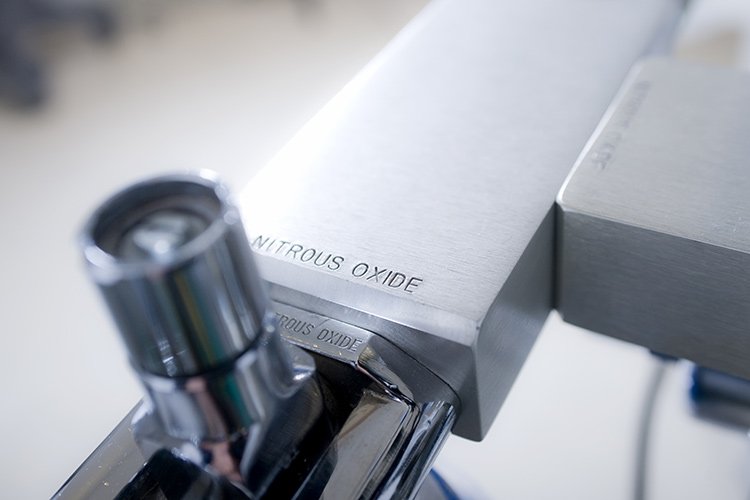
- Sedation by administering nitrous oxide through a nasal mask. The patient breathes a mixture of air, oxygen, and nitrous oxide in quantities tailored to their age and the duration of the procedure. The sedative effect is activated within a few seconds. At the end of the dental session, pure oxygen is then administered for a few minutes to allow the patient to fully recover. In this way, they can leave the dental clinic independently, drive home, and return without the help of others.
Depending on the concentration and duration of the administration of nitrous oxide, we have observed in our patients four levels of reaction (after an initial sense of dizziness). The first consists of tingling sensations in the arms and legs, warmth sensations throughout the body, and a general sense of well-being. Often, the patient describes it as a state of euphoria, floating, or bodily and mental lightness. In cases of deeper sedation, drowsiness, difficulty keeping the eyes open, and speaking, nausea may occur; - Sedation by administering minor tranquilizers, the so-called benzodiazepines, which are common tranquilizers and anxiolytics. Among the benzodiazepines we use is diazepam (or Valium). This type of conscious sedation by the dentist is used in more complex therapies, in elderly patients, patients with heart disease, diabetes, or hypertension.
- Alternative sedation through electroacupuncture, a minimally invasive technique that, thanks to its analgesic properties, allows surgical intervention without pain. Its characteristic is maintaining the perception of both touch and pressure, as well as heat and cold. It requires a preparation of 45-50 minutes to allow the patient’s body to produce endorphins.
The main advantages of vigilant sedation are that:
- The patient, in a state of tranquility, is able to actively collaborate with the dentist performing the dental therapy. The time required to perform the dental treatment is significantly reduced;
- The amount of analgesics and antibiotics that the patient will have to take is reduced because the number of dental sessions required to resolve the dental or periodontal problem is reduced;
- The patient has a quick and painless post-operative recovery.
The safety of conscious sedation is guaranteed by the presence, throughout the duration of the dental treatment, of an anesthesiologist. Professionals collaborate with our dental clinic, equipped with competence and experience in managing pain treatments. These professionals are able to constantly monitor the patient’s vital parameters and overall health. In this way, the dentist can focus exclusively on dental treatment.
This technique has contraindications, which we always inform the patient about in advance. Contraindications are specific to certain individuals in particular:
- Patients who have undergone surgical reconstruction of the eardrum, as nitrous oxide increases pressure and can cause eardrum perforation;
- Ophthalmic patients who have undergone vitrectomy surgery (total or partial removal of the vitreous body), using gases incompatible with nitrous oxide. In these cases, there is a risk of irreversible retinal detachment;
- Patients in the first 3 months of pregnancy;
- Patients who have a real inability to breathe through the nose due to temporary inflammations (cold, sinusitis, bronchitis) or physical malformations;
- Patients suffering from serious illnesses, such as acute bronchopneumonia, emphysema, multiple sclerosis, myasthenia, acute diaphragmatic hernia;
- Psychotic patients who are undergoing treatment with psychotropic drugs. In this case, the administration of nitrous oxide or benzodiazepines would constitute pharmacological excess;
- Patients with substance abuse issues, always due to a matter related to pharmacological excess.
About us
About Us
The Motta Jones Rossi & Associates Dental Clinic in Milan specializes in adult dentistry, pediatric dentistry, oral surgery, implantology, invisible orthodontics (e.g. Invisalign – invisible and transparent braces), treatment of periodontal diseases, wisdom teeth care, prevention and dental hygiene, 3D reconstructive surgery, and cosmetic dentistry. A dental center that supports the patient throughout their journey, providing therapeutic consultation, solutions for dental problems, and assistance.
Recent Posts
Severe gingival recession: causes, symptoms and treatment5 October 2026 - 15:49
Cosmetic Dentistry and the evolution of aesthetics in international dentistry30 September 2026 - 16:58
Gum infection: what should you do?11 September 2026 - 16:23
Dental sealants for adults: when to get them and how long they last12 August 2026 - 18:47

Come visit us
Medical Director
Dr. Enrico Riva
