
We will be happy to answer all your questions
PERIODONTAL DISEASE
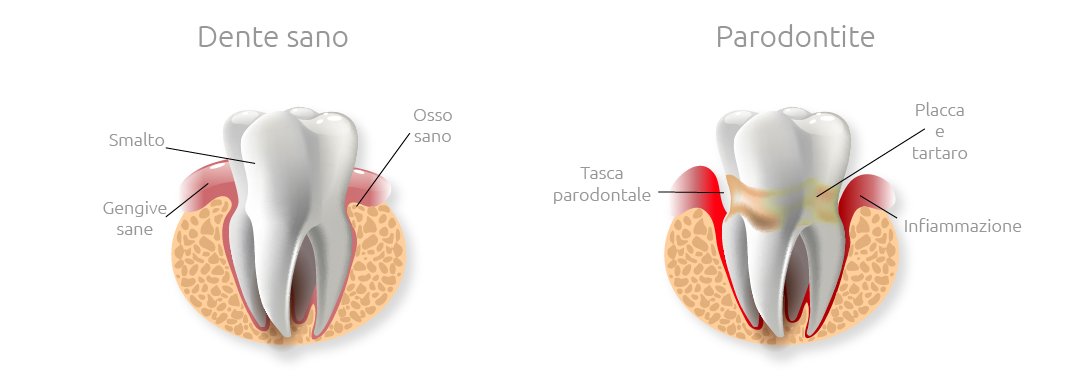
Our dental practice also treats periodontal disease, also known as periodontopathy. Periodontology is the branch of dentistry that deals with the diagnosis and treatment of diseases affecting the supporting structures of the teeth, known as the periodontium.
This includes the gums, the periodontal ligament (which connects the tooth to the bone), the root cementum (the tissue covering the tooth roots), and the alveolar bone (the part of the jaw that anchors the teeth).
In particular, periodontology focuses primarily on the study and treatment of periodontopathy.
What is commonly referred to as pyorrhea is actually the acute manifestation (with swollen gums and pus discharge from the gums) of periodontal disease.
KEY ASPECTS OF PERIODONTOLOGY
Below, we will cover some key aspects related to periodontology and the treatment of periodontal disease, specifically:
A[/av_dropcap1]t our dental clinic in Milan, our goal is to provide prompt treatment for periodontal disease. The known causes of this condition can be attributed to several factors: – A genetic predisposition, as with most dental-related conditions, which generally affect the overall health of the oral cavity; – A high bacterial load in the mouth, which stimulates plaque formation, often due to poor oral hygiene. In its early stages, bacterial plaque causes gingivitis, and if left untreated, it can develop into periodontopathy; – Smoking, which accelerates and worsens the progression of periodontal disease by weakening local tissues and creating favorable conditions for bacterial growth; – Stress, which weakens the immune system; – Pregnancy, a period in which hormonal fluctuations can make patients more prone to gingivitis and periodontal diseases; – Certain systemic conditions not strictly related to the oral cavity, including diabetes, various forms of rheumatoid arthritis, and congenital or acquired immune deficiencies.’ icon_select=’yes’ icon=’ue86b’ font=’entypo-fontello’ custom_id=” av_uid=’av-a4bh6c’ sc_version=’1.0′]
At our dental clinic in Milan, our goal is to provide prompt treatment for periodontal disease. The known causes of this condition can be attributed to several factors:
- A genetic predisposition, as with most dental-related conditions, which generally affect the overall health of the oral cavity;
- A high bacterial load in the mouth, which stimulates plaque formation, often due to poor oral hygiene. In its early stages, bacterial plaque causes gingivitis, and if left untreated, it can develop into periodontopathy;
- Smoking, which accelerates and worsens the progression of periodontal disease by weakening local tissues and creating favorable conditions for bacterial growth;
- Stress, which weakens the immune system;
- Pregnancy, a period in which hormonal fluctuations can make patients more prone to gingivitis and periodontal diseases;
- Certain systemic conditions not strictly related to the oral cavity, including diabetes, various forms of rheumatoid arthritis, and congenital or acquired immune deficiencies.
The first symptoms of periodontal disease reported by patients at our dental clinic include:
- bleeding gums, especially when brushing;
- pain in the gums;
- the formation of gaps between the teeth;
- swollen gums;
- gum thinning or recession;
- persistent bad breath;
- the presence of pus between the teeth and gums;
- increased tooth sensitivity when chewing;
- progressive tooth mobility.
In such cases, our professional dentists carry out a diagnosis of the disease using various innovative diagnostic tools, including:
- Periodontal probing, a minimally invasive procedure. It involves inserting a millimeter-calibrated probe between the tooth and gum, down to the bottom of the gingival sulcus. In the presence of the disease, bacterial colonization along the tooth root causes the gum to detach from the root and the supporting bone to resorb. This results in a periodontal pocket around the root surface. Over time, this can lead to tooth mobility and eventual tooth loss;
- Charting, which allows for the recording of the presence and depth of periodontal pockets, bacterial plaque, and bleeding. A complete mapping of the gingival condition is performed to monitor the progression of periodontopathy over time and assess the effectiveness of any ongoing periodontal treatment;
- Intraoral X-rays, which provide detailed radiographic information about the health of the teeth. They are able to show the condition of the hard structures of the periodontium (bone and root);
- Genetic testing, performed using a saliva sample to assess any genetic predisposition to periodontopathy. It offers a predictive evaluation;
- Microbiological testing, carried out on a sample of fluid from the gingival pocket to detect the presence of bacterial strains directly responsible for periodontal disease.
Periodontal disease can be successfully treated if diagnosed early. Even in more advanced stages, it is possible to stop its progression, which typically has a chronic degenerative nature.
A strong collaboration between the dentist, the dental hygienist, and the patient is essential for the effective treatment of periodontopathy. Once the diagnosis is made, the dentists working with our clinic determine the most appropriate treatment path for managing periodontal disease.
An initial treatment, which precedes all other phases and is known as initial or causal therapy, aims to improve the patient’s oral hygiene. This involves a significant and sustained reduction of bacterial plaque, as well as supragingival and subgingival tartar, using professional dental cleaning tools. Further targeted treatments follow this initial therapy.
The treatments that follow the initial therapy include:
- Root planing, also known as scaling or root planing, which involves subgingival smoothing of the tooth roots. This procedure is performed under local anesthesia;
- Antibiotic therapy, as periodontal disease is primarily caused by a bacterial infection. In many cases, taking antibiotics helps eliminate the bacteria in the periodontal pockets, making it possible to effectively treat periodontal disease;
- Laser therapy, which, when combined with the aforementioned treatments, helps eliminate bacteria. It is a non-invasive and painless procedure for the patient;
- Surgical therapy or periodontal surgery, used only after the previous treatment stages and in areas where deep periodontal pockets persist. This involves the surgical removal of gingival and bone pockets by reshaping the bone, gum, and tooth tissue. In some cases, techniques may be used to regenerate lost tissue;
- Mucogingival surgery, aimed at restoring the aesthetic and functional appearance of the gum tissue. Depending on the case, the procedure may involve adding, repositioning, or removing gingival tissue.
Maintaining the achieved state of periodontal health is the true key to the definitive treatment of periodontal disease. At the end of the treatment plan, the dentists at our clinic initiate the so-called maintenance phase of the periodontal system’s health.
During this phase, we schedule regular check-up appointments with our patients, often combined with professional oral hygiene sessions performed by the dental hygienist. The frequency of these visits varies depending on the patient’s previous condition and the periodontal status reached after therapy. The patient’s actual ability to maintain good daily oral hygiene is also a crucial factor.
Usually, during the initial monitoring period following the treatment cycle, we recommend a check-up at least every six months.
About us
About Us
The Motta Jones Rossi & Associates Dental Clinic in Milan specializes in adult dentistry, pediatric dentistry, oral surgery, implantology, invisible orthodontics (e.g. Invisalign – invisible and transparent braces), treatment of periodontal diseases, wisdom teeth care, prevention and dental hygiene, 3D reconstructive surgery, and cosmetic dentistry. A dental center that supports the patient throughout their journey, providing therapeutic consultation, solutions for dental problems, and assistance.
Recent Posts
Severe gingival recession: causes, symptoms and treatment5 October 2026 - 15:49
Cosmetic Dentistry and the evolution of aesthetics in international dentistry30 September 2026 - 16:58
Gum infection: what should you do?11 September 2026 - 16:23
Dental sealants for adults: when to get them and how long they last12 August 2026 - 18:47

Come visit us
Medical Director
Dr. Enrico Riva
